

There is one solar policy that unites almost everybody in this country. Reform will tell you it. The Greens will tell you it. Liberals will say it. Conservative associations, parish meetings, letters pages, the man behind you in the Co-op queue. Put them on the roofs instead.
It is a remarkable piece of political engineering, because it does four things at once. It sounds pro-renewable. It costs the person saying it nothing. It offends nobody. And it commits you to precisely no action, ever, anywhere.
That is the definition of a populist position. Not because the people saying it are stupid or acting in bad faith, because mostly they are neither. It is populist because it offers a painless answer to a genuinely painful question, and painless answers to painful questions are almost always wrong.
Why it feels right
I should say I understand the appeal, and I do not think it comes from a bad place.
Drive through any business park in this county and you will see acres of flat, empty, south-facing roof doing nothing at all. Warehouses. Supermarkets. Schools. Car parks baking in July. Then someone proposes covering farmland in panels and the reaction is instinctive: use the roofs you already have before you touch a field. It is a fairness instinct, and fairness instincts are usually worth listening to.
The problem is that this one does not survive contact with a calculator.
The arithmetic
Britain passed two million solar installations this March. Two thirds of them sit on the roofs of houses. That is the result of more than a decade of feed-in tariffs, zero-rated VAT, export guarantees and a real boom in homeowner enthusiasm. Everything Britain has managed to put on its roofs adds up to roughly 6.8GW.
A single large solar farm, Botley West up the road from us, is 840MW. One project, one grid connection, delivering about an eighth of what every homeowner in the country has achieved put together.
Run it the other way. The average new domestic system is 5.7kW, thirteen or fourteen panels. To replace Botley West and the proposed Cearn scheme in the Vale with rooftop generation you would need panels on something like 235,000 homes. There are roughly 300,000 households in the whole of Oxfordshire. Four roofs in every five, including the north-facing ones, the ones under trees, the listed ones, and the ones belonging to people who do not want them or cannot pay for them.
I know what you are thinking, because I thought it too. Not houses. Warehouses. All those enormous sheds along the A34 with nothing on them.
So let us take the warehouse industry’s own best case. The UK Warehousing Association estimates that if every suitable warehouse roof in Britain were covered, you would get about 15GW. Barbour ABI, more generously, says 25GW. The government’s target is 70GW by 2035. Cover every shed in the country and you are between a fifth and a third of the way there.
And then the detail that ought to settle it. Around 5% of warehouse roofs currently have solar on them. Payback is three to five years and it takes up to 80% off the electricity bill. This is not an idea nobody has had. It has been available, profitable for years, and nineteen out of twenty warehouse owners still have not done it. That is what “just put them on the roofs” amounts to as a plan: waiting for something to happen that has been free money for a decade and has not happened yet.
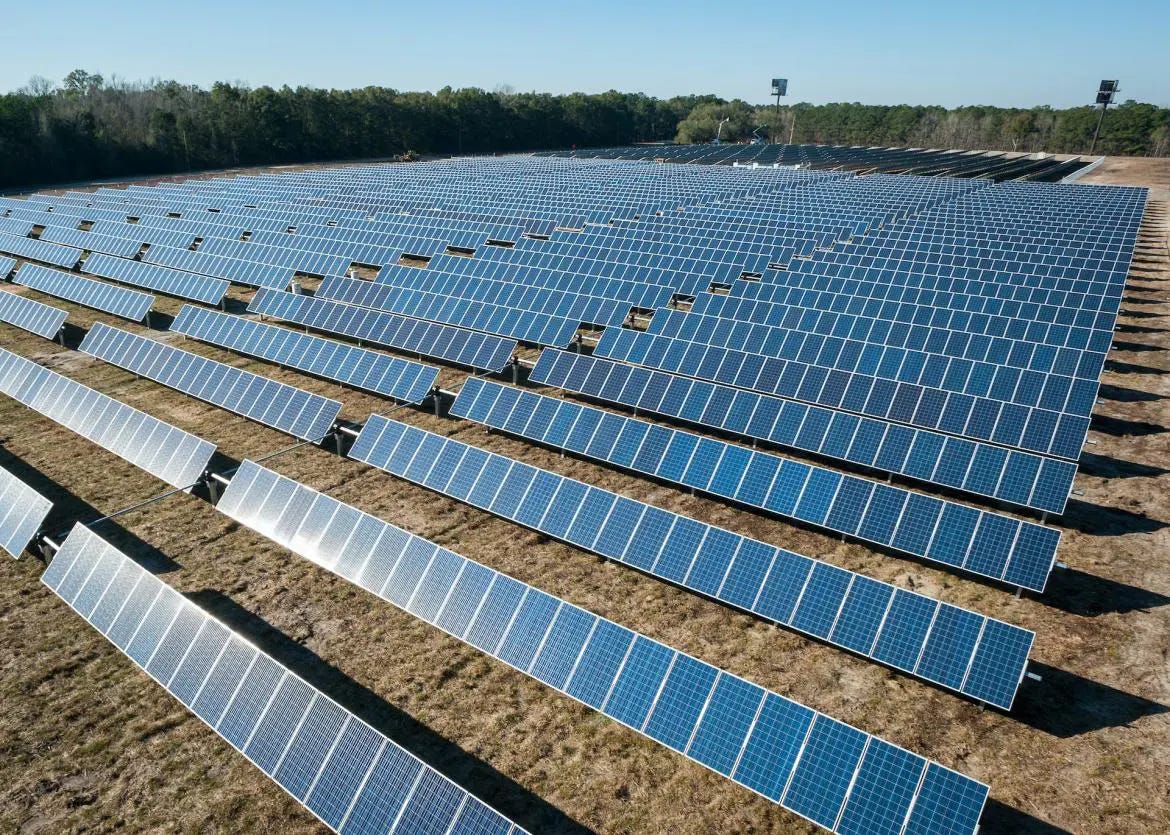
Then there is park and rides owned by the Councils, and here I can use Oxford City Council’s own figures rather than mine. When the city costed solar canopies over its park and ride sites, they came out at £900 to £1,400 per kilowatt installed. Field-mounted solar came in at about £450. Same pound, two to three times the clean power.
None of which is an argument against rooftop solar. I want much more of it than we have. I want us to be more forceful with warehouses, car parks and buildings and to have the government incentivise it further if needed be. That would be a good start!
The Future Homes Standard finally mandates it on new homes from next spring, sized properly rather than the token three panels developers have been getting away with, and it should have happened a decade ago. But that applies to new homes. There are around 27 million existing ones carrying no obligation at all.
Overall rooftop solar is not wrong. But it is small, uneconomical, slow, and unlikely to ever be enough.
Why slow is the whole problem
Here is the thing about carbon that makes climate different from almost every other political question.
It accumulates. A tonne we emit this year does not expire when we get our act together in 2035. It sits in the atmosphere warming things for centuries. Which means the total we emit between now and net zero is what determines how bad this gets, not the date we eventually arrive.
So delay is not neutral. Delay is emission. Every year we spend arguing about whether a field near Garford is the right field is a year of gas-fired generation setting the price and filling the sky, and that year does not come back.
This is why “do it, but do it the slower and more expensive way” is not a moderate position. It is the same position as not doing it, with better manners.
Whose problem this actually is
Imagine a child today, one who is 4 years old.
In 2030, the year the grid is supposed to be decarbonised, they will be eight. At school. In 2050, the year the country is meant to reach net zero, they will be twenty eight. Maybe with children of their own. Maybe with rent or a mortgage; but certainly with energy bills and a climate shaped entirely by decisions taken in rooms they were not allowed into.
That is the uncomfortable structure of this whole argument. The people who get to object are, overwhelmingly, people who will not be here for the consequences. The people who will live with the consequences cannot vote, cannot speak at a parish meeting, and do not get a say on a planning application.
I am not saying that to guilt anyone. Plenty of people objecting to solar farms are doing it precisely because they love a landscape and want to hand it on intact, which is an intergenerational instinct too, and an honourable one.
But you cannot hand on a landscape by handing on a climate that wrecks it. The chalk streams, the flood meadows, the Vale itself: none of that survives four degrees.
If I’m asked in twenty years what I did to help us decarbonise our energy system, “I argued that it should have gone on warehouse roofs instead” is not going to sound like much of an answer.
It’s not as bad as we think, either…
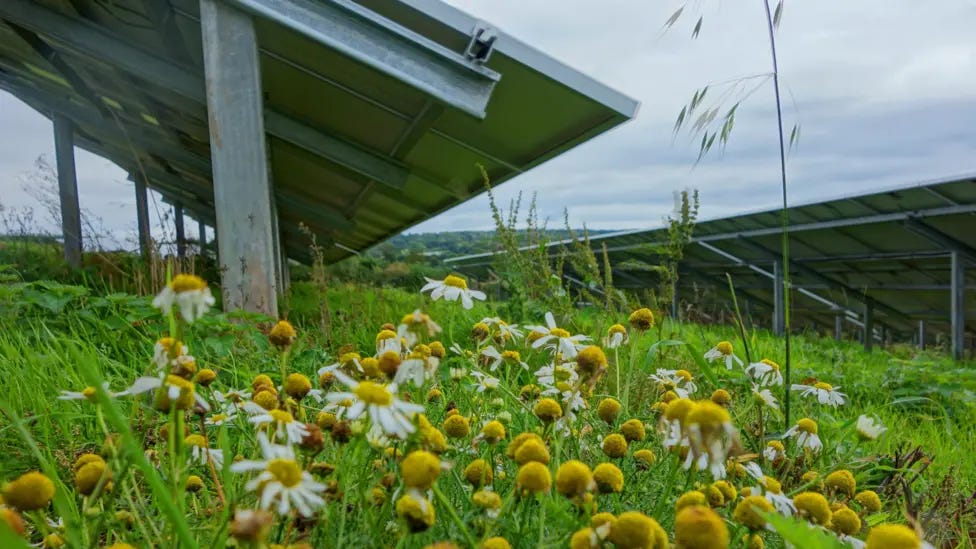
It is also worth saying that a solar farm is not the ecological dead zone people imagine! The land it usually replaces is arable monoculture, ploughed and sprayed annually, which is close to the worst thing for wildlife you can do with a field. Put panels on frames above grassland, stop the ploughing for forty years, add hedgerow and wildflower planting, and you generally end up with more biodiversity than you started with. Developers have to demonstrate a 10% net gain to get consent at all.
And unlike almost anything else the planning system approves, this is reversible: the panels sit on driven piles, not foundations, and at the end of the lease they come out and the field is a field again, with four decades of recovered soil underneath it. We consent housing on greenfield land and that is gone for good.
The money is running the same way
If the climate argument does not move you, the bill might.
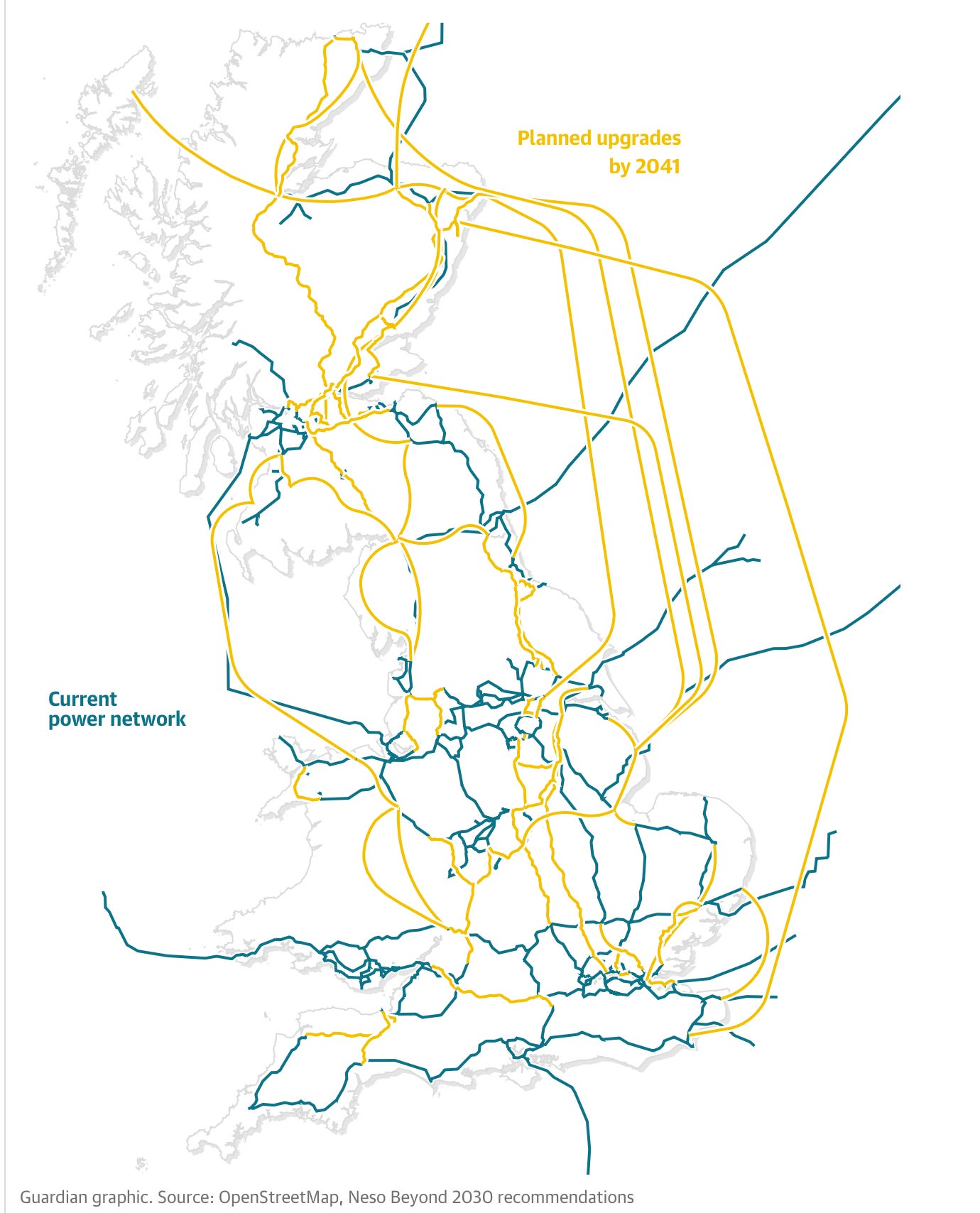
Britain is in the middle of one of the largest grid rebuilds in its history: five times more infrastructure by 2030 than we managed in the previous three decades, and over 4,000 miles of new power lines by 2041. The National Energy System Operator puts it at £64bn of transmission investment by 2030 and another £89bn after that. More than £150bn, largely paid for through surcharges on household bills. Yours and mine, with the Ofgem cap rising another 4% next month. It’s not ideal for any of us. But why?
This is so we can move electricity from wind farms in places like Scotland down to the places where it’s needed, and that means cables and pylons.
If you’ve ever been annoyed looking at a wind farm non-operational out of your plane window, it could well be because we don’t have this infrastructure yet to be able to move it.
Which produces the obvious grievance: why are we paying for infrastructure we did not ask for? Because the alternative costs more.
Our electricity is far more expensive than comparable countries for one main reason, which is that gas-fired generation sets the price most of the time. Every convulsion in the international gas market, and there have been two in four years, lands directly on our bills. Homegrown generation and the wires to carry it are the way out of that trap. Professor Keith Bell at Strathclyde puts it plainly: without enough transmission capacity we stay dependent on fossil fuels, stay exposed to price shocks, and emit more.
Not building is not the free option. It is the expensive one with the cost hidden, and a good deal of it deferred onto people too young to complain.
Which brings me home
Every council in Oxfordshire has declared a ‘climate emergency’. Oxford City in January 2019, the Vale that February, South and West Oxfordshire the same year, the county council in April. The Vale committed to cutting district emissions 75% by 2030. All six councils signed an energy strategy saying installed solar in this county needs to rise from around 300MW to about 1,900MW.
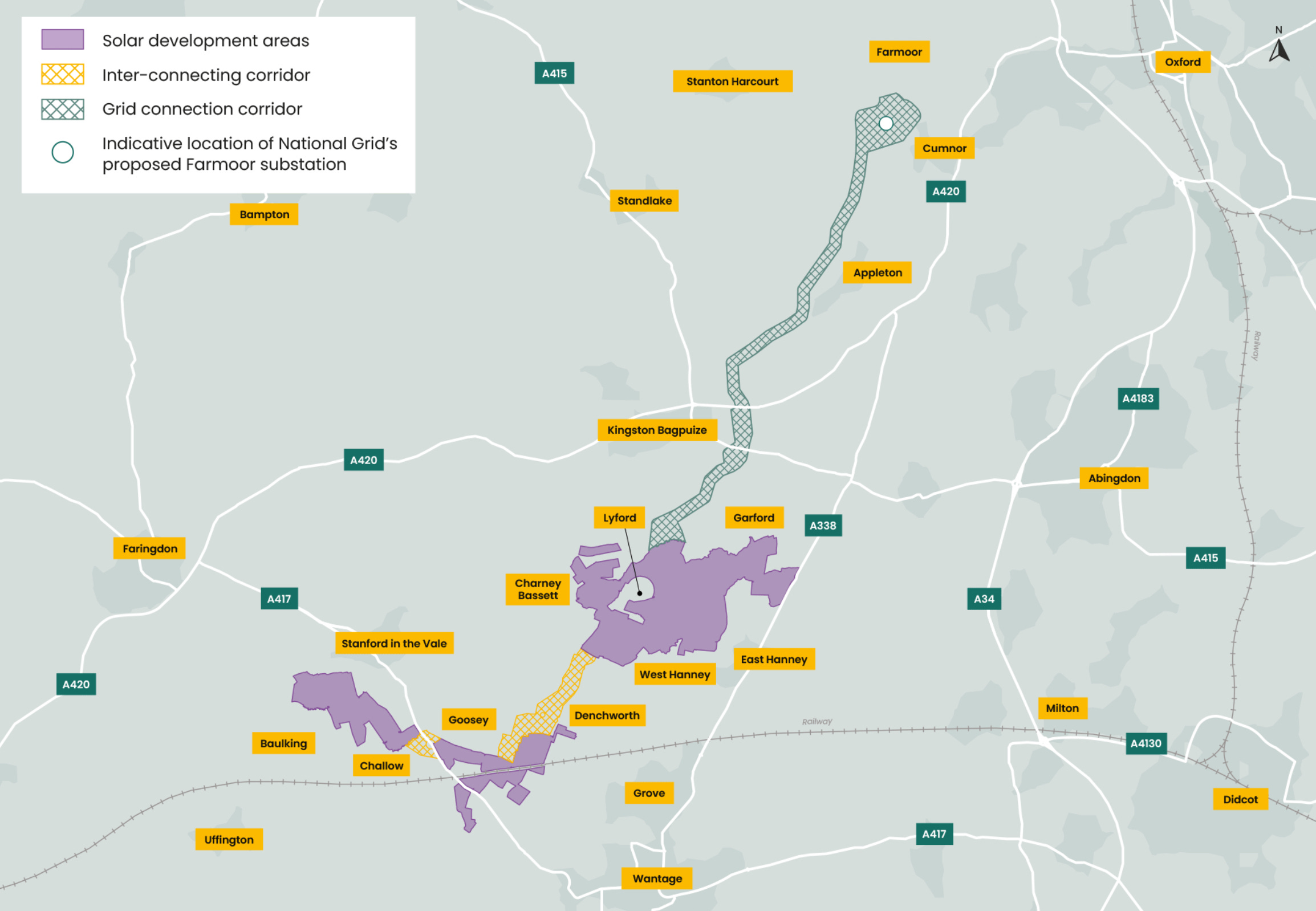
At the moment there are applications for two schemes near to us, Botley West and Cearn (see below), which between them come to 1,340MW. Five sixths of the target we set ourselves. But the conversation locally has been, almost entirely, about how to stop them.
I am not here to tell you either scheme is good or appropriate on its own terms. To be honest, I’m not enough of an expert in the subject to be able to determine that anyway. And the government decides these centrally, not councils.
Part of the Cearn site is provisionally mapped as best and most versatile soil. Several field parcels sit in Flood Zones 2 and 3, on a catchment that ends in Abingdon, and anyone who has watched the Ock in February will want that modelled properly.
The cable route north to Farmoor passes Denchworth, Kingston Bagpuize and Appleton. Cearn, Botley West and the White Horse Reservoir are each being assessed as though the other two did not exist, which is a genuine failure of the system and one I will keep pressing the county council on.
Every one of those is a reason to engage hard and extract better terms. Proper flood modelling. A cable route timed so it does not take three villages apart for two summers. A community benefit fund that means something across forty years. A decommissioning bond so the land comes back. A battery safety plan written with Oxfordshire Fire and Rescue and published in full.
But none of this is a reason to do nothing
Every country that decarbonised did it by building things where somebody could see them.
There is no version where the panels go somewhere nobody minds, because nowhere is nobody’s.
The choice in front of us is not between fields and roofs; it is between doing more of this - all over the country - in the next ten years, or handing the bill, in money and in weather, to people who are currently learning to read.
They will not remember which parish objected. They will only know whether we moved.
There are a couple more old chestnuts;
'we prefer a community led approach.' This is too Utopian, too slow, if investment is there we must act.
'we have to take people with us on climate, solar farms antagonise.'
this can be said about any sacrifice made for climate and let's be real, sacrifice must be made at a macro level, putting responsibility on individuals is not a plan.
You should be higher in government than you are, wherever that is